
(this page was created automatically. In case of formatting issues, please visit the official Wiki Page)
Notifications
Overview
Overview
Notifications in Inspire Design give users clear, visual feedback about their actions and the state of the system. They show whether a process has completed successfully, whether a problem has occurred, or how an ongoing process is progressing.
Notifications appear as Local, Global, and Toast Notifications. Together with the Notification Icon in the header and the Notification Panel on the right side of the dashboard, they form a connected notification experience across the application.
Anatomy
Notifications within Inspire Design have five major elements:
- The Notification Icon inside the header.
- The Notification Panel that opens on the right side of the dashboard.
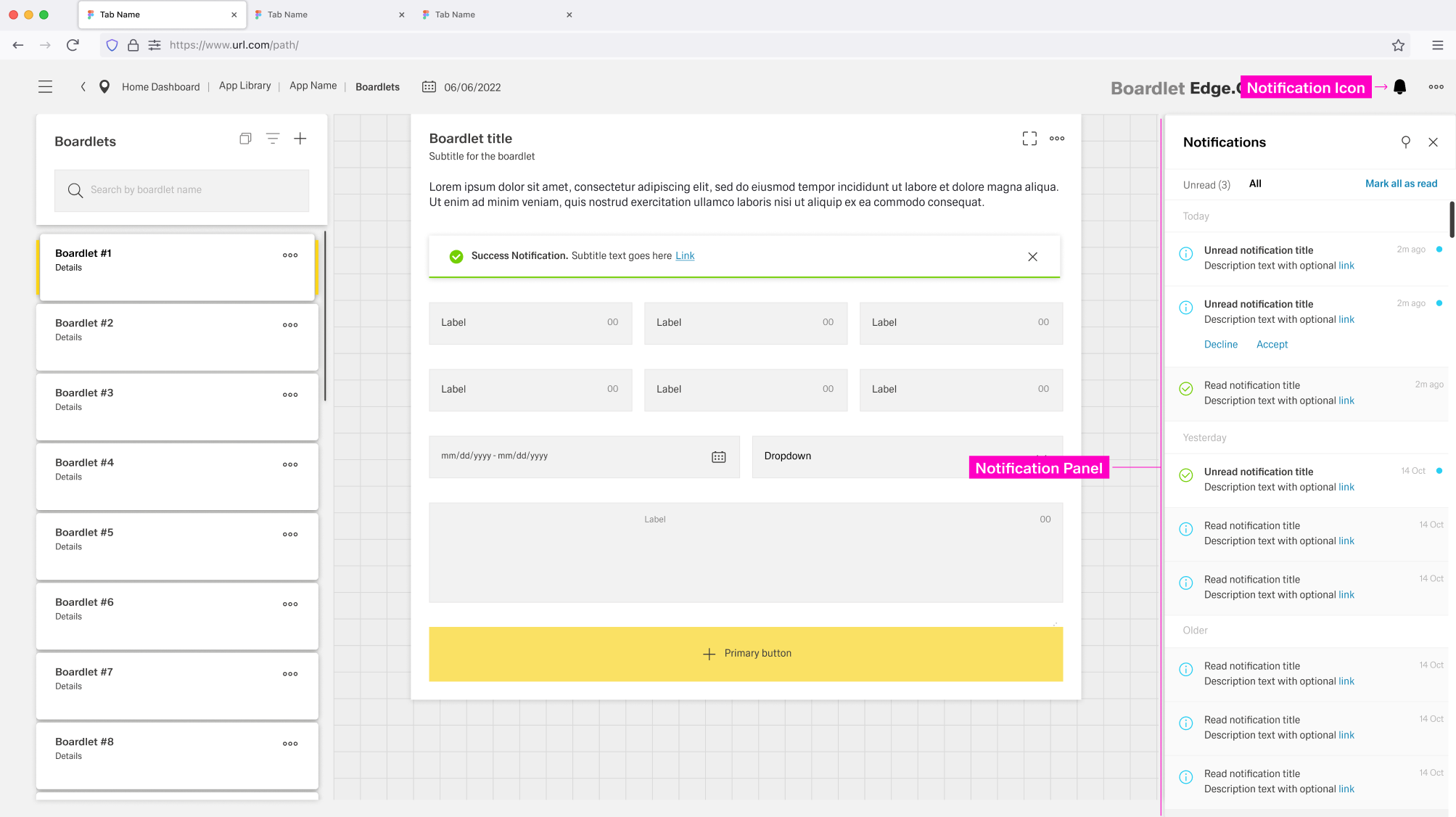
- Local Notifications in the form of Inline Notifications that are part of boardlets.
- Global Notifications as a pop-up at the top of the dashboard.
- Toast Notifications as a pop-up at the to-right of the dashboard.
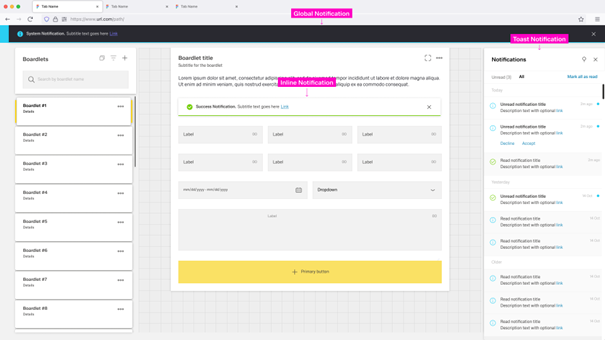
The appearance of notification elements may vary between different types of notifications.
Inspire Design differentiates between the following types of notifications:
- Error Notification – Colored red, signals critical errors.
- Warning Notification – Colored orange, announces problems that may result in errors.
- Success Notification – Colored green, signals a successful process.
- System Notification – Colored blue, reports system information.
- Progress Notification – Colored blue with a progress bar, updates the user on an ongoing process.

Notification Icon
The Notification Icon is part of the header toolbar on the right side of the dashboard header.
The icon is located at the far right, immediately to the left of the overflow menu, if one is present.
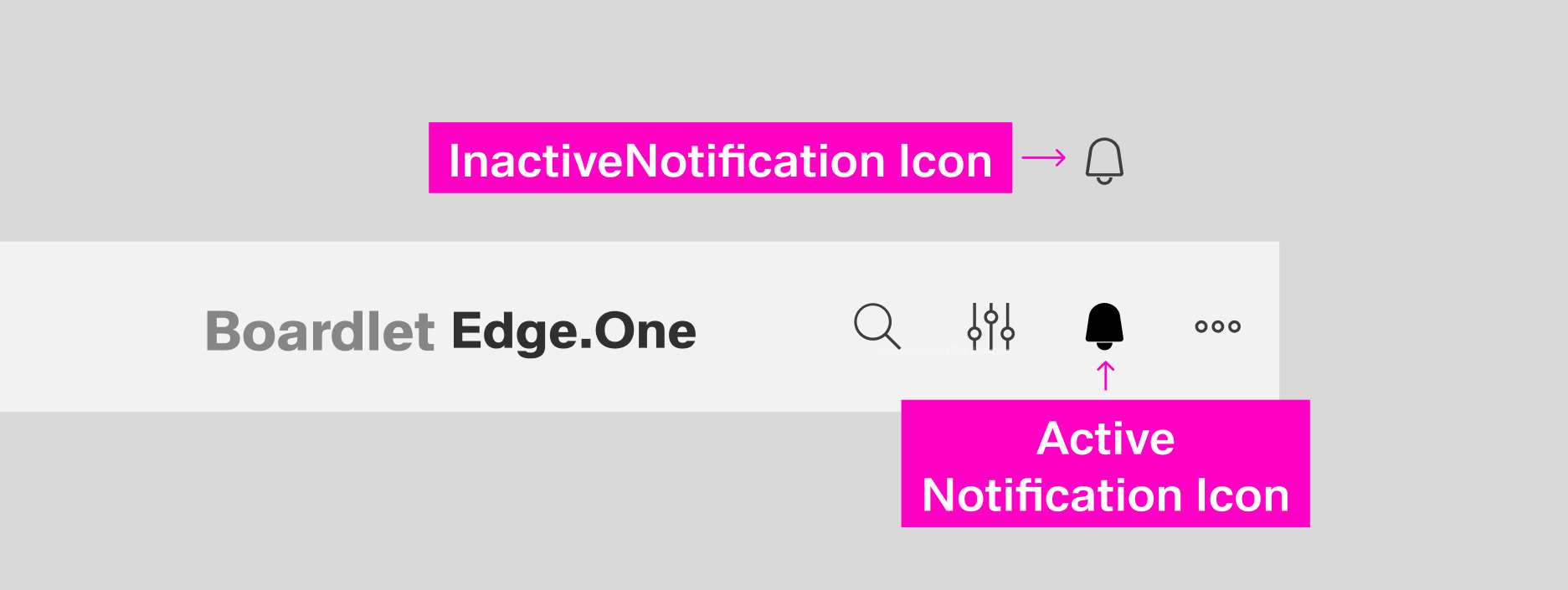
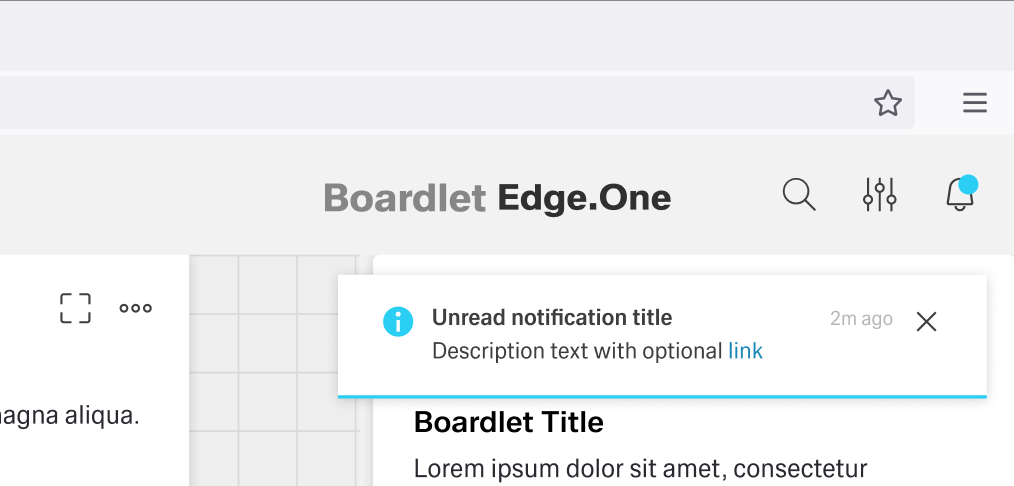
When a new and unread notification appears, the Notification Icon gains a small blue indicator at the top-right.
The indicator disappears when the user has no unread notifications or opens the Notification Panel.
If the notification is an error, warning, or success notification, a special secondary icon appears to the left of the Notification Icon inside the header.
This icon matches the type of notification in appearance and vanishes when the user interacts with the notification.
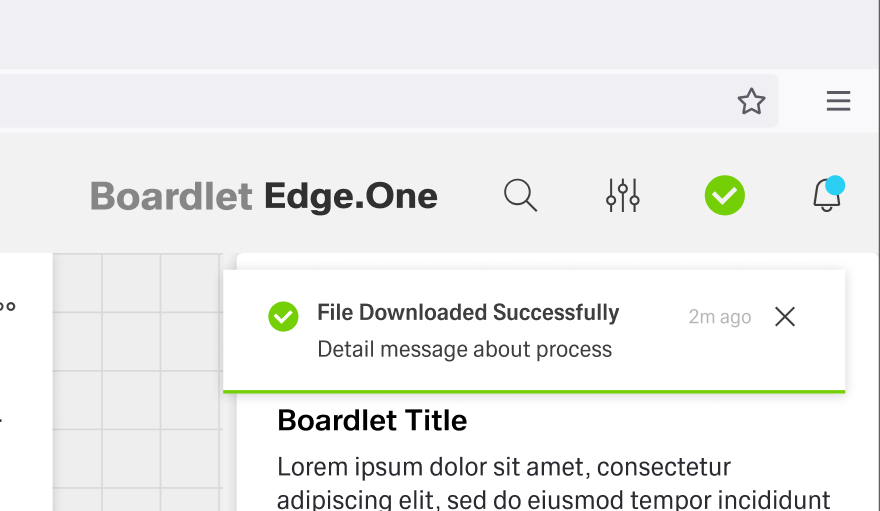
A Progress Notification adds a progress indicator to the left of the Notification Icon.
It is circular and actively shows progress instead of being a static icon.

Notification Panel
Users can open the Notification Panel by clicking the Notification Icon in the header or on a Toast Notifiaction.
It opens on the right side of the dashboard and has a fixed width.
The Notification Panel can be closed by clicking the close action in the toolbar or by clicking outside the panel.
Users can anchor the panel like the navigation panel.
An anchored panel can only be closed by clicking the close action.
The Notification Panel has two tabs: Unread and All.
- Unread – This tab displays all notifications the user has not interacted with. This is the default tab.
- All – This tab shows all information the user has received so far.
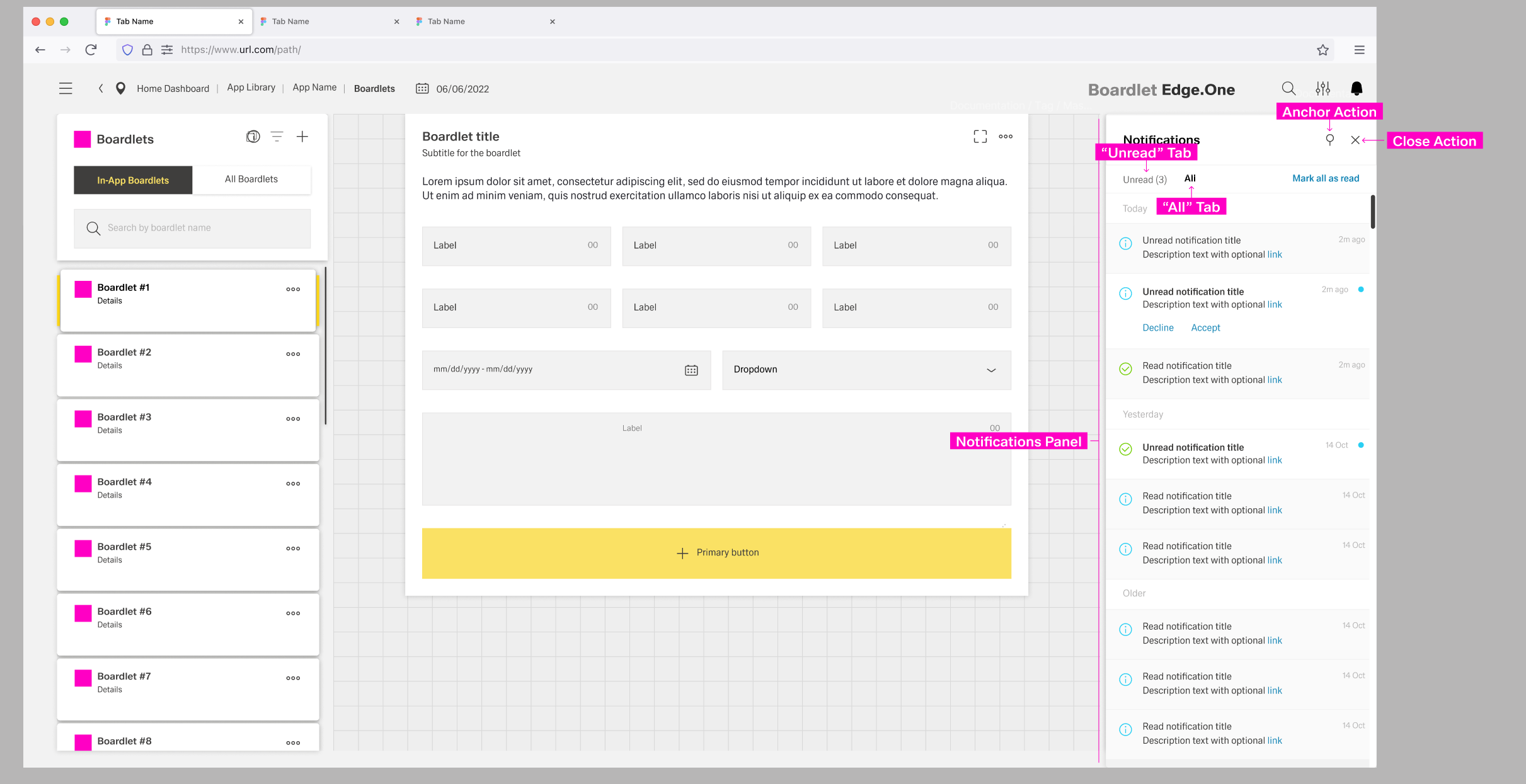
Unread notifications have a small blue status indicator at the top-right and a bold title.
By clicking the status indicator, users can set a notification as read.
Read notifications are grayed out and have a non-bold title.
Both tabs have an action to set all notifications as "read" to the left of the content switch.
Notifications are ordered and grouped by their date of appearance, regardless of the active tab.
Toast Notification
The Toast Notification appears in the top-right corner and visually floats above the dashboard.
Only one Toast Notification can be visible at a time.
They do not diappear automitcally.
The color of the Toast Notification depends on the type of notification it contains.
The general layout stays the same between notifications, with the Progress Noti
- 01 Notification Icon – Signals the type of notification and matches the icon in the header, except for the progress notification.
- 02 Title
- 03 Time Stamp – Shows when the notification popped up.
- 04 Close Action – Allows the user to close the toast notification.
- 05 Description – A short text explaining the notification.
- 06 Actions – Influence the process in progress.

- 01 Notification Icon - Signals the type of notification and matches the icon in the header, except for the progress notification.
- 02 Title
- 03 Time Stamp - Shows when the notification popped up.
- 04 Close Action - Allows the user to close the toast notification.
- 05 Description - A short text explaining the notification.
- 06 Actions - Influence the process in progress.
- 07 Progress Bar - Actively shows updates on the progress.
Global Notification
Global Notifications appear as a bar at the top of the dashboard as a pop-up. Up to two Global Notifiactions can be visible at any time. They disappear after a set amount of time or if the user clicks the "close" button, if one is present.
Global notifications do not support the progress variant.
[TODO: Image]
- 01 Notification Icon - Signals the type of notification and matches the icon in the header.
- 02 Title - Few words describing the notification message.
- 03 Subtitle - Additional information clarifying the intend of the message.
- 04 Close Action - Optional close button for the notification
Inline Notifications
For more information on the component of the same name: Inline Notification
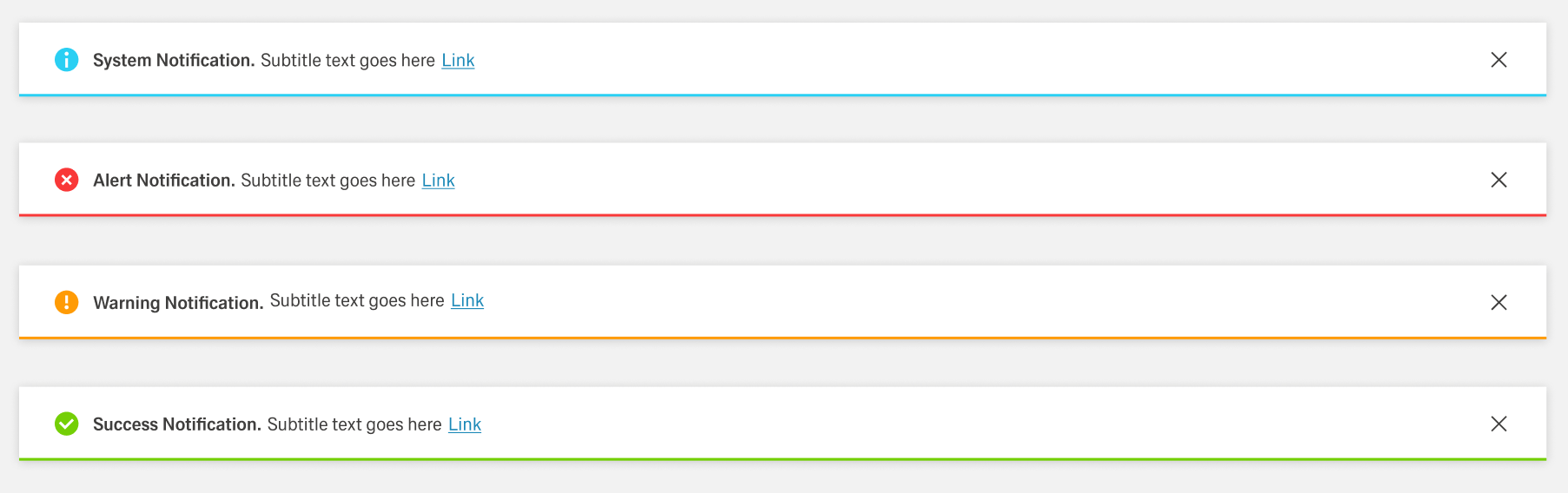
Inline Notifications appear inside components or boardlets in general. Their realm of influence is limited to the space they appear in and they are not listed in the Notification Panel. Inline Notifications have four states, determined by the type of notification. The content can vary by use case.
- Error Notification — Colored red; signals critical errors.
- Warning Notification — Colored orange; announces problems that may result in errors.
- Success Notification — Colored green; signals a successful process.
- System Notification — Colored blue; reports system information.
Best Practices
Usage
Global Notification
Global Notifiactions give feedback on major user actions, for example saving a change inside a table. They appreare at the end of a process and usually have an impact on the system, like changing data. They are always tied to user interaction or the inability for a user to perform an action.
Global Notification disappear ofter a set amount of time. This time should tailored to the notification length, so that users of all reading speeds can comprehend the message.
At the same time, it should only be as long as absolutely required, since the Global Notification is intrusive, blocking the header bar. In addition, the user should be able to close the Global Notification unless it's presence is absolutely required.
Inline Notification
Inline Notifications deliver a direct response to a user action inside a larger process. One example for an Inline Action would be filling out an text field inside a form. The feedback, i.e. the notification, would be that the input is valid or invalid.
As shown in the example, Inline Notifications are used for immediat feedback on small scale user actions. They usually focus on sub-steps in a series and are tied to actions that on their own do not have a large impact.
Inline Notifications are not permanent, being deleated when the user abandones the process by for example switching dashboard. In addition, they are not displayed inside the notification panel.
These notification usually change the layout of the boardlet they appeare in, making them quite disruptive. Thereby they should only be used sparingly. For example, if a form has multiple text fields with specific requirements, they all might only need one Inline Notification. This notification could than cover the message for all text fields, instead of every text field having their own notification.
It is also recomended to include the close button unless the presence of the notification is absolutely required.
Toast Notification
In contrast to Global and Inline Notifications, Tosat Notifications are not focues of feedback of user actions. They inform the user about the system and background processes, for example downloading a file and the completion message afterwards. They can also include action beyond "closing" to influence the topic of the notifdication.
In contrast to Inline and Global Notifications, these Notifications are dynamic and live. They can replace each other, for exampe a success notification replacing a progress notification.
Toast Notifications are the only permanent form of notifications, being stored inside the Notification Panel. To not clutter the Notification Panel, the number of Toast Notifications sent should be no more than absolutely nessissary.
Text
Texts inside should be consize concrete, using active verbs and simple language whenever possible. They should avoid complicated or foreign words and abreviation. Inline and Global Notifications should never have a message with multiple rows and Toast Notifications should avoid messages longer than three rows.
